
Every UK-licensed slot displays an RTP percentage somewhere — usually buried in the info screen nobody clicks. It's one of the few numbers in online gambling that's independently tested, regulated, and genuinely useful, yet most players walk past it without knowing what it actually tells them. Here's what RTP means, what it doesn't mean, and how to actually use it.
In This Guide:
What RTP Actually Means
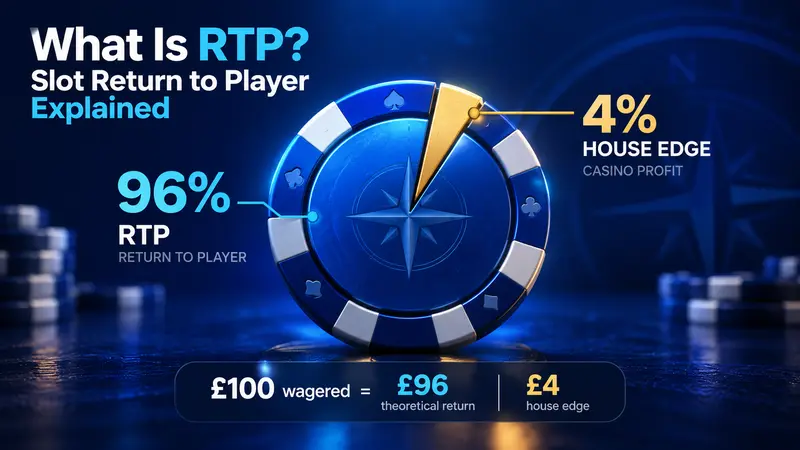
RTP stands for Return to Player — the theoretical percentage of every pound wagered on a slot that gets paid back to players, calculated over a very large number of spins. A slot with a 96% RTP is mathematically designed to return £96 for every £100 wagered, over the long run. The remaining £4 is the house edge — the built-in margin that keeps the game profitable for the operator.
The word "theoretical" is doing a lot of work in that definition. RTP isn't calculated from a handful of real sessions — it's derived from the game's underlying mathematics and confirmed through millions of simulated spins. That's precisely why it can't predict what happens on your next ten spins, or even your next thousand. It describes where the numbers settle eventually, not what any individual player experiences on a Tuesday evening.
This matters because RTP is often misread as a promise. It isn't one. A 97% RTP slot can still produce a losing session, a losing night, or a losing month for any given player — the percentage only becomes meaningful at a scale no single player will ever personally reach. What RTP actually gives you is a fair, regulated way to compare one game's long-term generosity against another's.
RTP vs. Volatility — Two Different Things
RTP tells you how much comes back over time. It says nothing about how it comes back — and that second part is what volatility (sometimes called "variance") describes.
Low volatility slots pay out more frequently, but in smaller amounts. Sessions feel steadier — your balance dips and recovers in small increments, rarely swinging wildly in either direction.
High volatility slots pay out less often, but wins can be substantially larger when they land. Sessions on these games can include long dry spells punctuated by occasional big hits.
Here's the part that catches people out: two slots can share an identical 96% RTP and feel completely different to play. A low-volatility 96% RTP game might deliver small, frequent wins that make a session feel relaxed and sustainable. A high-volatility 96% RTP game with the same long-term payback could produce forty minutes of nothing followed by one large win — or forty minutes of nothing and no win at all before the session ends.
Neither is "better" in absolute terms. It depends entirely on what kind of session you're looking for, and how much bankroll swing you're comfortable with. RTP and volatility work together — checking only one tells you half the story.
What Counts as a Good RTP in the UK
Most UK-licensed online slots fall somewhere between 94% and 97%+, with plenty of well-known titles sitting at or above 96%. As a rough guide:
96%+ is generally considered strong for an online slot. 94-95.9% is fairly typical — not poor, just less generous over the long run. Below 94% is on the lower end for online play, though still within what UKGC licensing permits.
One genuinely useful fact for comparison: online slots at UK-licensed casinos typically carry noticeably higher RTPs than the equivalent games on a physical casino floor. Lower overheads for online operators translate into better long-term terms for players — one of the few structural advantages online play has over land-based.
It's also worth knowing that the same slot title can sometimes exist in multiple RTP configurations across different casinos or platforms — operators occasionally license variants of a popular game with slightly different RTP settings. The lesson isn't to distrust the number, just to check it in the specific game you're about to play rather than assuming it matches what you saw quoted elsewhere.
UKGC Regulation and Why You Can Trust the Number
RTP isn't something operators are free to advertise however they like. Under UK Gambling Commission licensing conditions, RTP figures must be independently tested before a game goes live, and operators are required to make that information available to players. This is one of the clearest, most concrete protections that comes with playing at a UKGC-licensed site rather than an unregulated one — the number on the screen has actually been verified against what the game does.
This ties directly into the broader licensing framework we cover in our UK casino licensing guide — RTP disclosure is just one piece of a much wider set of player protections that UKGC licensing requires. If you're not sure whether a site you're considering is properly licensed in the first place, our guide on how to verify a UKGC-licensed casino walks through exactly what to check.
Where to Find RTP Before You Play
Most slots display their RTP inside the game itself — usually in an "i" (information) icon, a paytable screen, or a rules/help menu accessible before you spin. Some casino lobbies also let you filter or sort games by RTP directly, though this feature varies by operator.
A practical tip: always check the RTP inside the specific game you're about to play, rather than relying on a number you saw quoted in a review or forum post. Game studios occasionally release multiple RTP versions of the same title for different markets or operators, so the figure attached to "Big Bass Bonanza" on one site isn't guaranteed to match another.
Frequently Asked Questions
What does RTP mean?
RTP stands for Return to Player — the theoretical percentage of all money wagered on a slot that is paid back to players over a very large number of spins. A 96% RTP means the game is designed to return £96 for every £100 wagered, over the long run.
Is a higher RTP always better?
A higher RTP generally means better long-term value, but it isn't the whole picture. Volatility — how often and how large wins are — shapes what a session actually feels like far more than a percentage point or two of RTP does. A high-RTP, high-volatility game can still produce long losing streaks.
Does RTP guarantee I'll win?
No. RTP is a theoretical average calculated over millions of simulated spins, not a promise for any individual session. Short-term results can vary enormously in either direction — RTP tells you what to expect eventually, not what will happen next spin.
What's the difference between RTP and house edge?
They're two sides of the same number. If a slot has a 96% RTP, its house edge is the remaining 4% — the built-in margin the operator keeps over the long term. RTP and house edge always add up to 100%.
Do all UK casinos have to disclose RTP?
Yes. UK Gambling Commission licensing requires operators to make RTP information available to players, and game RTPs are independently tested before they can go live. This is one of the clearest protections UKGC licensing provides that unlicensed sites don't guarantee.
The Bottom Line
RTP is one of the few genuinely useful, regulated numbers in online slots — but it works best alongside volatility, not in isolation. A high RTP with volatility that doesn't suit your bankroll or session style can still feel disappointing, while a slightly lower RTP matched to how you actually like to play can feel far more rewarding.
Every operator featured on PlayCompass is UKGC licensed, meaning the RTPs on their games have been independently tested rather than simply claimed. For more on what that licensing actually guarantees, see our UK casino licensing guide, and always play within the limits set out in our responsible gambling guide.
Compare All Featured Casinos
View our full list of UKGC licensed UK casino sites.
View All Featured Casinos →