If you have ever been asked to upload a copy of your passport or a bank statement before withdrawing from an online casino, you have experienced KYC — Know Your Customer. It is a legal requirement for every UKGC-licensed operator, and understanding why it exists, what it involves, and what your rights are as a player makes the process significantly less frustrating.
KYC is not a casino trying to delay your withdrawal or make your life difficult. It is a regulatory obligation designed to protect players, prevent underage gambling, and stop criminal funds from being processed through gambling accounts. This guide explains the process from start to finish — what documents are required, when casinos can request them, how long verification takes, and what happens if you refuse. Every casino featured on PlayCompass is UKGC licensed and required to carry out KYC in full compliance with UK law.
In This Guide:
What is KYC?
KYC stands for Know Your Customer. It is a set of identity verification procedures that regulated businesses — including banks, financial institutions, and gambling operators — are legally required to carry out before providing services to a customer.
In the context of online casinos, KYC means verifying that you are who you say you are, that you are old enough to gamble, that you are not on a self-exclusion register, and that the funds you are using are legitimate. It is not unique to gambling — the same process applies when you open a bank account, apply for a mortgage, or use a money transfer service.
For UKGC-licensed operators, KYC is not optional. It is a condition of their operating licence. Operators that fail to carry out adequate KYC face significant regulatory consequences — the Gambling Commission has issued multi-million pound fines to operators found to have inadequate identity and anti-money laundering procedures.
Why Do UK Casinos Carry Out KYC?
According to the UK Gambling Commission, there are three core reasons why online gambling operators verify your identity:
1. To confirm you are old enough to gamble. Gambling is restricted to adults aged 18 and over in Great Britain. Operators are legally required to verify a player's age — failing to do so is one of the most serious regulatory breaches a gambling company can commit.
2. To check you have not self-excluded. If you have registered with GamStop or self-excluded directly with an operator, the casino must take reasonable steps to prevent you from opening a new account or circumventing your exclusion under a different identity. KYC checks help enforce self-exclusion agreements. You can read more about how self-exclusion works in our GamStop guide.
3. To confirm your identity and prevent money laundering. Gambling platforms can be targeted by criminals seeking to convert illegitimate funds into apparently clean winnings. KYC is a core component of the UK's Anti-Money Laundering (AML) framework — operators must be able to identify their customers and monitor their transactions for suspicious activity.
Beyond these three primary reasons, KYC also allows operators to identify duplicate accounts, enforce bonus restrictions (most bonuses are limited to one per customer), and meet their broader obligations under UK data protection and financial crime law.
What Documents Do Casinos Ask For?
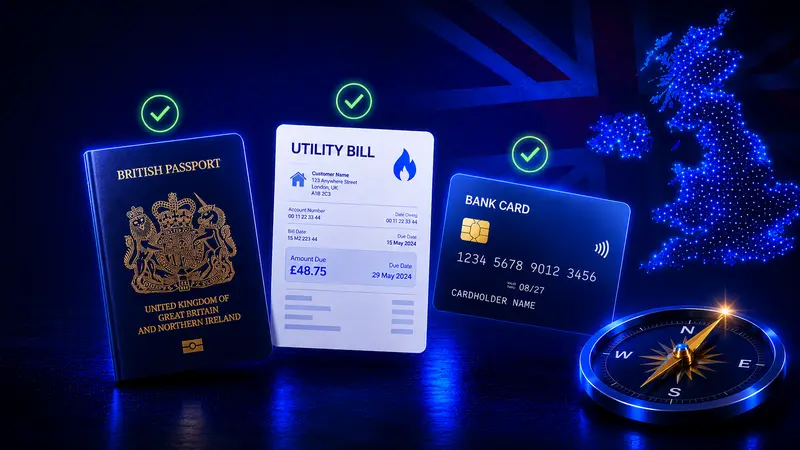
The specific documents a casino requests can vary by operator, but the standard KYC document set for UK players covers three categories:
Proof of Identity (POI) — A government-issued document with your photo and full name. Accepted documents typically include:
- Valid passport
- UK driving licence (full or provisional)
- National identity card (for EEA nationals)
Proof of Address (POA) — A document confirming your current residential address, typically required to be dated within the last three months. Accepted documents typically include:
- Utility bill (gas, electricity, water)
- Bank or building society statement
- Council tax bill
- HMRC correspondence
Proof of Payment Method — Some operators ask you to verify the payment method used to deposit, particularly for card payments or e-wallets. This typically means a screenshot of your payment account or a photo of your card showing the last four digits.
The UKGC does not specify exactly which documents operators must accept or reject — that is left to individual operators to determine. However, operators are required to have clear, documented processes and cannot demand information that goes beyond what is proportionate and necessary for verification purposes.
When Does KYC Happen?
The timing of KYC requests varies between operators, but the UKGC sets a clear minimum standard: operators must verify a player's age within 72 hours of account opening and deposit. If age cannot be confirmed within that window, the account must be frozen — the player cannot continue gambling until verification is complete.
In practice, most UKGC-licensed operators now carry out identity verification at one of three points:
At registration — Some operators verify identity before allowing any deposit or play, particularly those using automated electronic verification tools. This is becoming increasingly common as verification technology has improved.
After first deposit, within 72 hours — The operator allows play to begin but initiates KYC immediately, completing verification within the regulatory window. The account is frozen if documents are not received or approved in time.
At first withdrawal request — Some operators defer document collection until a player requests a withdrawal. This is permitted under UKGC rules as long as age verification has already been completed, but it means a withdrawal can be delayed while documents are processed.
Operators can also trigger additional KYC checks at any point during a customer's relationship with them — for example, if spending patterns change significantly or if a large withdrawal is requested. There is no time limit on how long an account can be frozen for non-age-related KYC checks.
How Long Does Verification Take?
Verification timelines vary considerably between operators. The main factors are whether the casino uses automated electronic verification, the quality of the documents submitted, and how busy the operator's compliance team is at the time.
Automated verification — Many modern UKGC-licensed operators use third-party electronic identity verification tools that can confirm a player's identity in minutes using database checks, without requiring document uploads at all. This is the fastest route and increasingly the default for straightforward cases.
Manual document review — Where documents need to be reviewed by a compliance team, most operators aim to complete verification within 24 to 72 hours of receiving complete, legible documents. This window can extend if documents are unclear, if proof of address does not match the registered details, or if additional information is required.
The most common reasons for verification delays are: blurry or cropped document images, expired ID, proof of address older than three months, name or address discrepancies between documents and account details, and incomplete submissions. Submitting clear, current, matching documents at the first request is the fastest way through the process.
What Happens if You Refuse KYC?
If you decline to provide the documents a casino requests, the operator has the right — and in many cases the legal obligation — to freeze your account. They cannot allow you to continue gambling without completing the required checks.
In terms of your funds, the position is straightforward: your deposited funds must be returned to you. A UKGC-licensed operator cannot simply keep your money because you declined to verify your identity. However, any bonus funds or winnings generated while the account was unverified may be voided, as the operator was not in a position to confirm your eligibility at the time.
If you fail to respond to KYC requests within a reasonable timeframe, the operator may close your account entirely. This is within their rights under their terms and conditions, and it is a legitimate response to non-compliance with a legal requirement.
It is worth noting that refusing KYC at one operator can create complications elsewhere. Regulatory databases share information about high-risk accounts, and a pattern of refusing verification across multiple operators can attract additional scrutiny.
Source of Funds and Enhanced Due Diligence
Beyond standard identity verification, some players encounter a deeper level of checks known as Enhanced Due Diligence (EDD) or source of funds verification. This is the point at which a casino asks not just who you are, but where your money comes from.
Source of funds checks are triggered when a player's spending patterns suggest a higher risk — either of problem gambling or of money laundering. Operators are required to monitor customer behaviour and intervene when thresholds are reached. Common triggers include large single deposits, rapid escalation of spending, or cumulative losses above a certain level over a given period.
When source of funds checks are triggered, operators may request:
- Recent payslips or employment contract
- Bank statements showing regular income
- Evidence of savings, investments, or inheritance
- Business accounts (for self-employed players)
This is not the casino being intrusive for its own sake. It is a legal obligation under the UK's anti-money laundering framework, and operators face serious regulatory consequences for failing to conduct adequate EDD on high-risk accounts. The UKGC's Financial Risk Assessment framework — currently in development — is expected to formalise and standardise these checks further across the industry.
If you are asked for source of funds information, providing clear documentation quickly is the most effective way to resolve the check and resume normal account activity.
Your Data and Privacy Rights
Submitting personal documents to an online casino is understandably a concern for many players. Understanding your data rights helps clarify what operators can and cannot do with the information you provide.
All UKGC-licensed operators are legally required to comply with UK GDPR and the Data Protection Act 2018. This means they must handle your personal data lawfully, store it securely, use it only for the purposes for which it was collected, and not retain it longer than necessary.
Document submissions must be made through secure, encrypted channels — a legitimate casino will never ask you to send identity documents via unencrypted email or through a third-party messaging app. If a casino's verification process asks you to do this, treat it as a red flag.
You have the right to request access to the personal data an operator holds about you, to request correction of inaccurate data, and in certain circumstances to request deletion. Operators are required to have a clear privacy policy explaining how they handle your data — this should be accessible on their website.
Before submitting any personal documents, always confirm the casino holds an active UKGC licence. You can verify this in seconds using the Gambling Commission's public register. Our full guide on how to verify a casino's UKGC licence walks through the process step by step.
KYC and PlayCompass Casinos
Every casino featured on PlayCompass holds an active UKGC licence and is required to operate a full KYC programme in compliance with Gambling Commission standards. We do not feature operators with inadequate verification processes or a history of significant KYC-related regulatory failures.
KYC is one of the markers we look at when assessing an operator's overall trustworthiness. A casino with a smooth, clear, and prompt verification process is a signal of a well-run operation. Operators that routinely delay verifications, request unnecessary documents, or use KYC as a pretext to delay legitimate withdrawals are not the kind of operators we recommend.
If you are looking for a licensed, reputable UK casino where the verification process is straightforward, you can compare all of our featured operators on the PlayCompass homepage.
Frequently Asked Questions
What does KYC stand for at online casinos?
KYC stands for Know Your Customer. It is the identity verification process that all UKGC-licensed online casinos are legally required to carry out before allowing players to deposit, play, or withdraw funds.
What documents do UK casinos ask for?
UK casinos typically ask for a government-issued photo ID (passport or driving licence), proof of address (utility bill or bank statement dated within 3 months), and sometimes proof of payment method. For enhanced checks, they may also request proof of source of funds such as payslips or bank statements.
How long does casino KYC verification take?
Most online casinos complete KYC verification within 24 to 72 hours of documents being submitted. Some operators use automated verification tools that can confirm identity within minutes. The UKGC requires operators to verify a player's age within 72 hours of account opening and deposit — if they cannot, the account must be frozen.
Can a casino withhold my winnings if I have not completed KYC?
Yes. UKGC-licensed casinos are permitted to withhold withdrawals until KYC verification is complete. They cannot keep your funds permanently — once verified, any pending withdrawals must be processed — but they can delay payment until your identity has been confirmed.
What happens if I refuse to complete KYC?
If you refuse to provide the documents requested, the casino can freeze your account and withhold withdrawals. They may also close your account entirely. Your deposited funds should be returned to you, but any bonus funds or winnings generated while the account was unverified may be voided.
Why is a casino asking for proof of income or source of funds?
Source of funds checks are part of Enhanced Due Diligence (EDD) — a deeper level of KYC triggered when a player's spending patterns suggest a higher risk of problem gambling or money laundering. Operators may request payslips, bank statements, or other evidence to confirm that the funds being used for gambling are legitimate and affordable. This is a legal requirement under UK anti-money laundering regulations.
Is it safe to send ID documents to an online casino?
Yes, provided the casino is UKGC licensed. Licensed operators are legally required to handle personal data in compliance with UK GDPR and data protection law. Always verify a casino's licence before submitting any personal documents — you can check at gamblingcommission.gov.uk/public-register/businesses.
Do I have to complete KYC before I can play?
Not always immediately. Under UKGC rules, operators have 72 hours to verify your age after you open an account and make a deposit. Some operators ask for verification upfront before allowing any play; others allow limited play during the verification window. However, withdrawals are typically blocked until KYC is fully complete.
What is the difference between KYC and AML?
KYC (Know Your Customer) is the identity verification process — confirming who a player is. AML (Anti-Money Laundering) is the broader framework of rules designed to prevent criminal funds from being processed through gambling accounts. KYC is a core component of AML compliance — you cannot have an effective AML process without first knowing who your customers are.
The Bottom Line on Casino KYC
KYC is a legal requirement, not a casino policy choice. Every UKGC-licensed operator must verify your identity — the only question is when and how. Understanding what is required, submitting clear documents promptly, and knowing your rights if a casino delays or mishandles the process puts you in a much stronger position as a player.
The key points to remember: operators must verify your age within 72 hours of account opening. They can withhold withdrawals until KYC is complete but cannot keep your deposited funds permanently. Source of funds checks are a legitimate legal requirement, not harassment. And you should always verify a casino's UKGC licence before submitting any personal documents — every casino on PlayCompass has been verified and holds an active licence.
Play at Verified, UKGC Licensed Casinos
Every casino on PlayCompass holds an active UKGC licence and operates full KYC compliance. Compare trusted operators and find the right one for you.
View All Featured Casinos →